

You may be noticing a softer jawline, looser skin under your chin, or facial laxity that bothers you, but not enough to make you comfortable with the idea of surgery. Treatments that promise skin tightening without a facelift can sound like the obvious middle ground.
The problem is that “non-surgical” covers a wide range of treatments. Some devices work entirely from the surface of the skin, while Endolift uses a very fine optical fiber beneath the skin to deliver laser energy directly into the treatment area. That difference affects what the procedure can potentially accomplish, how it feels, what recovery looks like, and which concerns it can realistically address.
Choosing a treatment without understanding those differences can lead to unrealistic expectations. A minimally invasive laser cannot reproduce every result of surgery, and a procedure that is appropriate for mild laxity may not be the right answer for more advanced sagging or a different source of facial fullness.
If you are asking what is Endolift, it helps to look beyond the phrase “laser skin tightening.” Understanding how the procedure works, which areas can be treated, what results may develop over time, and where the current evidence has limitations can help you decide whether it belongs in your aesthetic treatment plan.
How Does Endolift Work Beneath the Skin?
Endolift is a minimally invasive laser procedure that delivers energy below the surface of the skin through a thin optical microfiber.
The Endolift system uses a 1470 nm diode laser. Rather than passing laser energy through the surface from an external handpiece, the provider guides a sterile microfiber through the subcutaneous tissue. No traditional surgical incision is required.
The 1470 nm wavelength interacts strongly with water-containing tissue and can also affect fat. The controlled thermal effect is intended to produce several responses within the treatment area:
- Contraction and remodeling of connective tissue
- Stimulation of new collagen formation
- Improvement in skin laxity
- Remodeling of tissue beneath the skin
- Reduction of small localized fat deposits in selected areas
The result is different from simply adding volume with filler. Endolift is generally used to improve tissue firmness and contour rather than replace lost facial volume.
The LASEmaR 1500 laser platform used for Endolift has FDA 510(k) clearance as a prescription laser surgical instrument. Its cleared indications include applications in plastic and aesthetic medicine and laser-assisted lipolysis.
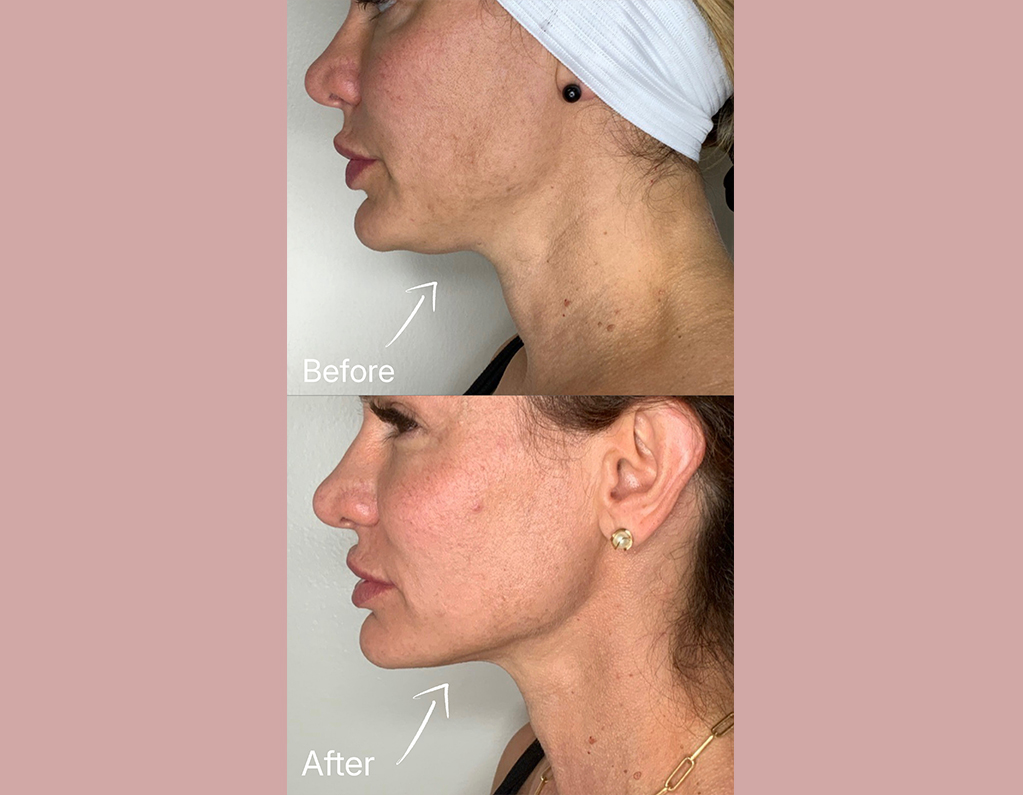
What Areas Can Endolift Treat?
Endolift is commonly associated with lower-face and neck contouring because those are areas where mild skin laxity and small pockets of fat frequently occur together.
According to the manufacturer’s treatment protocols, facial treatment areas can include the lower eyelid, mid-to-lower face, jawline, area beneath the chin, and neck. Body applications may include areas such as the inner arms, abdomen, buttocks, knees, inner thighs, and ankles.
At White Coat Glam, Endolift is offered primarily for people looking to improve facial definition, loose-looking skin, and selected areas of unwanted localized fat without a traditional surgical lift.
The treatment may be discussed for concerns such as:
- A less defined jawline
- Mild jowling
- Skin laxity beneath the chin
- Mild neck laxity
- Small pockets of submental fat
- Changes in facial contour associated with aging
- Selected areas of body laxity
Not every concern in these areas has the same cause. For example, fullness beneath the chin may come from fat, loose skin, anatomy, muscle position, or a combination of factors. That is why an evaluation should come before deciding that Endolift is the appropriate treatment.
How Is Endolift Different From External Laser Skin Tightening?
Many aesthetic devices deliver radiofrequency, ultrasound, or laser energy from outside the skin. Endolift takes a different approach because the fiber carrying the laser energy is introduced into the tissue beneath the surface.
That placement allows energy to be delivered directly into the subdermal treatment plane.
It also means Endolift is better described as minimally invasive, not completely noninvasive. There are no conventional surgical incisions, but a microfiber still enters beneath the skin.
This distinction matters when you compare procedures. A topical or external device may require no penetration of the skin at all. Endolift may provide a different degree and depth of tissue interaction, but it also involves technique-dependent risks that need to be considered.
Does Endolift Remove Fat?
Endolift can be used to target small localized areas of fat because the 1470 nm laser can create a thermal effect within adipose tissue.
That does not make Endolift a replacement for traditional liposuction.
The manufacturer describes the procedure as capable of selective lipolysis when appropriate, particularly in areas such as beneath the chin. The goal is typically refinement of a relatively small area rather than removal of a large volume of fat.
A systematic review published in 2024 also found studies reporting improvements in localized adipose tissue in areas including the jowls, abdomen, thighs, and arms. However, the authors emphasized the need for larger controlled studies to strengthen the evidence.
If excess fat is your primary concern, your provider should determine whether Endolift offers enough correction or whether another body or facial contouring procedure better matches your goal.
When Do Endolift Results Appear?
One reason Endolift can be confusing is that there may be both an early and a gradual component to the result.
Thermal contraction of tissue can produce an initial change in firmness or contour. However, collagen remodeling does not happen immediately.
The manufacturer states that results may continue developing for several months and can improve for up to approximately six months as collagen remodeling progresses.
That means evaluating the treatment only a few days afterward may not tell you what the eventual outcome will look like.
Results also vary according to factors such as:
- Your starting degree of skin laxity
- Skin thickness and tissue quality
- The area treated
- Amount of localized fat
- Treatment parameters
- Age and collagen response
- Provider technique
- Your overall aesthetic goal
No provider can guarantee an exact degree of tightening for every patient.
How Long Do Endolift Results Last?
There is no single duration that applies to every patient.
Endolift creates tissue remodeling rather than placing a permanent implant or physically removing excess skin. Collagen produced after treatment can contribute to longer-lasting improvement, but the normal aging process continues.
Manufacturers describe Endolift results as long-lasting, and published studies have reported persistent improvements during follow-up periods. However, the research is not yet strong enough to establish one universal duration for every treatment area and patient.
That limitation is worth emphasizing. A 2024 systematic review found encouraging results across a range of aesthetic applications but called for larger controlled trials. A separate systematic review published in 2025 was more cautious, concluding that existing studies had significant risk of bias, inconsistent treatment parameters, and insufficient high-quality evidence to make broad claims about efficacy and safety.
In practical terms, your outcome may last longer than the period in which you first see improvement, but future aging, weight changes, and tissue changes can eventually affect the treated area.
What Is Recovery Like After Endolift?
Endolift is generally performed as an outpatient procedure and usually involves much less recovery than surgical facial lifting.
That does not mean you should expect absolutely no reaction afterward.
Temporary effects may include:
- Swelling
- Bruising
- Tenderness
- Redness
- Mild discomfort
- Temporary changes in sensation in the treated area
White Coat Glam notes that swelling or bruising may occur for a short period after Endolift and that collagen remodeling continues after the initial recovery.
The exact recovery experience depends on the treatment area, amount of energy used, extent of treatment, and individual response. Your provider should explain what is normal, what activities to limit, and which symptoms should prompt you to contact the clinic.
What Are the Risks of Endolift?
Endolift involves laser energy delivered beneath the skin, so provider training, anatomical knowledge, laser settings, and technique matter.
Although many published Endolift studies have reported relatively mild and temporary side effects, the available evidence has limitations. Potential complications associated with subdermal laser procedures may include burns, prolonged swelling, irregular contour, infection, pigmentation changes, nerve-related symptoms, scarring, or unwanted fat loss depending on the area and technique.
The 2025 systematic review of Endolift literature specifically cautioned that available studies lacked standardized parameters and that the evidence was not strong enough to make sweeping claims about safety.
That does not mean complications are expected. It means the procedure should be treated like a medical aesthetic treatment rather than a risk-free beauty service.
Who May Be a Good Candidate for Endolift?
Endolift may be worth discussing if you have mild to moderate skin laxity and want improvement without committing to surgical lifting.
Someone interested in the procedure may have early jowling, a softer jawline, loose skin beneath the chin, or a combination of mild laxity and localized fat.
It may be less appropriate if you expect a dramatic facelift-level transformation. Significant excess skin, advanced facial laxity, or substantial fat deposits may require a different approach.
Your medical history also matters. Before treatment, your provider should review relevant health conditions, medications, previous procedures, skin characteristics, and the specific anatomy of the area you want treated.
Endolift vs. a Facelift: What Is the Real Difference?
The biggest difference is not simply downtime. It is what each procedure physically changes.
A surgical facelift can reposition deeper facial tissues and remove excess skin. That gives surgery the ability to correct more advanced laxity in a way that a minimally invasive laser cannot duplicate.
Endolift does not remove large amounts of excess skin. Instead, it uses controlled laser energy to encourage tissue contraction, collagen remodeling, and, where appropriate, treatment of limited localized fat.
For someone with relatively early changes who wants a more defined appearance without surgery, that difference may be exactly what makes Endolift appealing. For someone expecting a major correction, it may be the reason another treatment makes more sense.
Deciding Whether Endolift Fits Your Goals
Knowing what Endolift is is only useful if you can connect the technology to the change you actually want to see.
The procedure occupies a space between completely external treatments and traditional surgery. It works beneath the skin, can address mild laxity and selected pockets of fat, and produces changes that continue developing as collagen remodels. At the same time, results vary, the procedure has real risks, and the clinical evidence is still developing.
White Coat Glam offers Endolift in Miami for patients interested in minimally invasive facial and selected body contouring. A consultation allows your provider to examine the area that concerns you, determine what is contributing to the change you see, and explain whether Endolift can realistically produce the level of improvement you are looking for.
Frequently Asked Questions About Endolift
Is Endolift actually a laser treatment?
Yes. Endolift uses a 1470 nm diode laser connected to a thin optical microfiber that delivers energy beneath the skin.
Is Endolift noninvasive?
Not technically. Endolift does not involve traditional surgical incisions, but a microfiber is introduced beneath the skin. “Minimally invasive” is a more accurate description.
Is the Endolift laser FDA-cleared?
The LASEmaR 1500 laser platform used for Endolift has FDA 510(k) clearance as a prescription laser surgical instrument, including indications related to plastic and aesthetic medicine and laser-assisted lipolysis.
Can Endolift tighten a sagging jawline?
Endolift may improve mild to moderate laxity and definition along the lower face and jawline. It cannot remove significant excess skin in the same way a surgical facelift can.
Can Endolift get rid of a double chin?
The treatment can be used to address small areas of localized fat beneath the chin while also targeting tissue laxity. More substantial fullness may require a different treatment approach.
When will I see Endolift results?
An initial tightening effect may be visible relatively early, while collagen-related improvements can continue developing for several months. The manufacturer notes that improvement may continue for up to about six months.
How many Endolift treatments are needed?
Some Endolift protocols are designed around a single treatment, but there is no universal schedule appropriate for every patient. The treatment area, degree of laxity, desired result, and response to the first procedure can affect the plan.
Is Endolift painful?
Experience varies. Endolift protocols may be performed with or without local anesthesia depending on the treatment and patient. You may feel sensations associated with the microfiber and laser energy, and tenderness can occur afterward.
How much downtime is there after Endolift?
Downtime is generally shorter than with surgery, but temporary swelling, bruising, tenderness, or redness can occur. Your individual recovery depends on how extensively you are treated.
Is Endolift better than Morpheus8?
Neither treatment is universally better. Morpheus8 uses radiofrequency microneedling, while Endolift delivers laser energy beneath the skin through an optical fiber. Your degree of laxity, concerns, skin characteristics, desired result, and tolerance for treatment can influence which option makes more sense.
Can Endolift replace a facelift?
Endolift may be appropriate for mild to moderate laxity, but it cannot replicate the degree of tissue repositioning and excess-skin removal possible with surgery. People with advanced sagging may need a surgical consultation to achieve the result they want.
Are Endolift results permanent?
No aesthetic treatment stops the aging process. Endolift may create longer-lasting collagen remodeling, but skin and underlying tissues continue changing with age, weight fluctuations, sun exposure, and other factors.